1. Introduction: The High Cost of Manual Payroll Processing
Managing employee payroll manually using Microsoft Excel spreadsheets, paper registers, and disjointed email threads is one of the most risk-prone administrative tasks in any organization. As an enterprise grows beyond 20 employees, manual payroll processing inevitably introduces calculation errors, delayed payouts, employee dissatisfaction, and severe statutory compliance penalties from tax authorities.
In modern enterprises, an automated Human Resource Management System (HRMS) transforms monthly salary processing from a stressful multi-day ordeal into a streamlined 1-click execution. By unifying daily attendance logs, mobile GPS punches, biometric hardware sync, leave accruals, and expense reimbursements directly into a central payroll engine, organizations achieve 100% mathematical precision while cutting administrative overhead by over 85%.
2. Consolidating Attendance, Overtime & Leave Balances
The foundation of accurate payroll calculation is real-time attendance data. In manual systems, HR staff spend days collecting physical attendance sheets, cross-checking leave application emails, and manually calculating overtime hours across different departments. An automated HRMS eliminates this friction by consolidating all attendance data streams in real time:
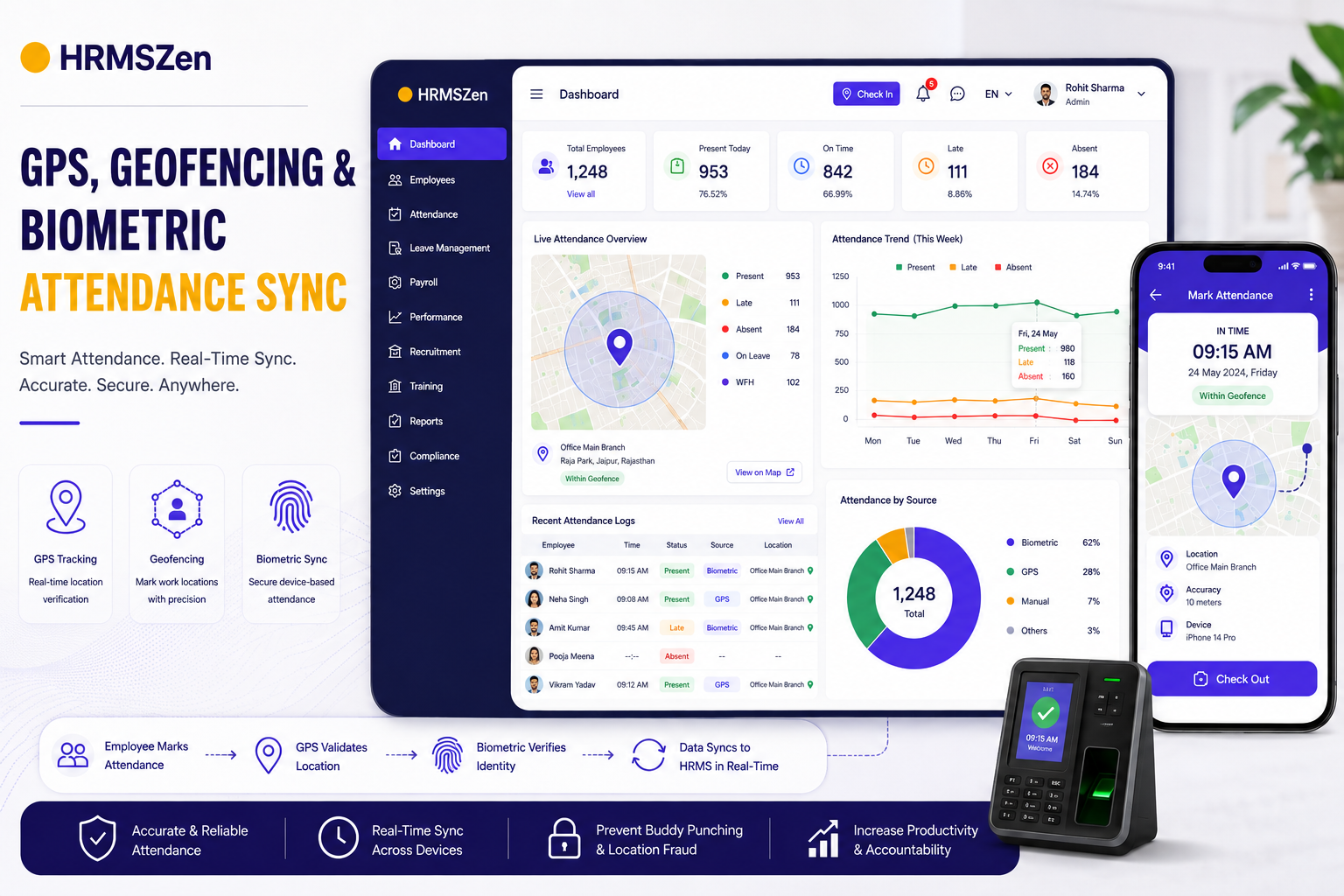
- Automated Attendance Fetching: Daily punch logs from biometric fingerprint scanners, facial recognition gates, RFID turnstiles, and mobile GPS geofenced apps flow automatically into the monthly attendance register.
- Leave Accruals & Encashment Rules: Approved casual leave (CL), sick leave (SL), earned leave (EL), and maternity leave days are automatically deducted from balances. Unpaid leave (LWP) days trigger exact pro-rata salary deductions without human intervention.
- Overtime (OT) Slabs & Approvals: Approved overtime hours are calculated against configurable company policy slabs (e.g., 1.5x or 2.0x standard hourly rate) and automatically added to gross earnings.
3. Statutory Compliance Engine: PF, ESI, TDS & Professional Tax
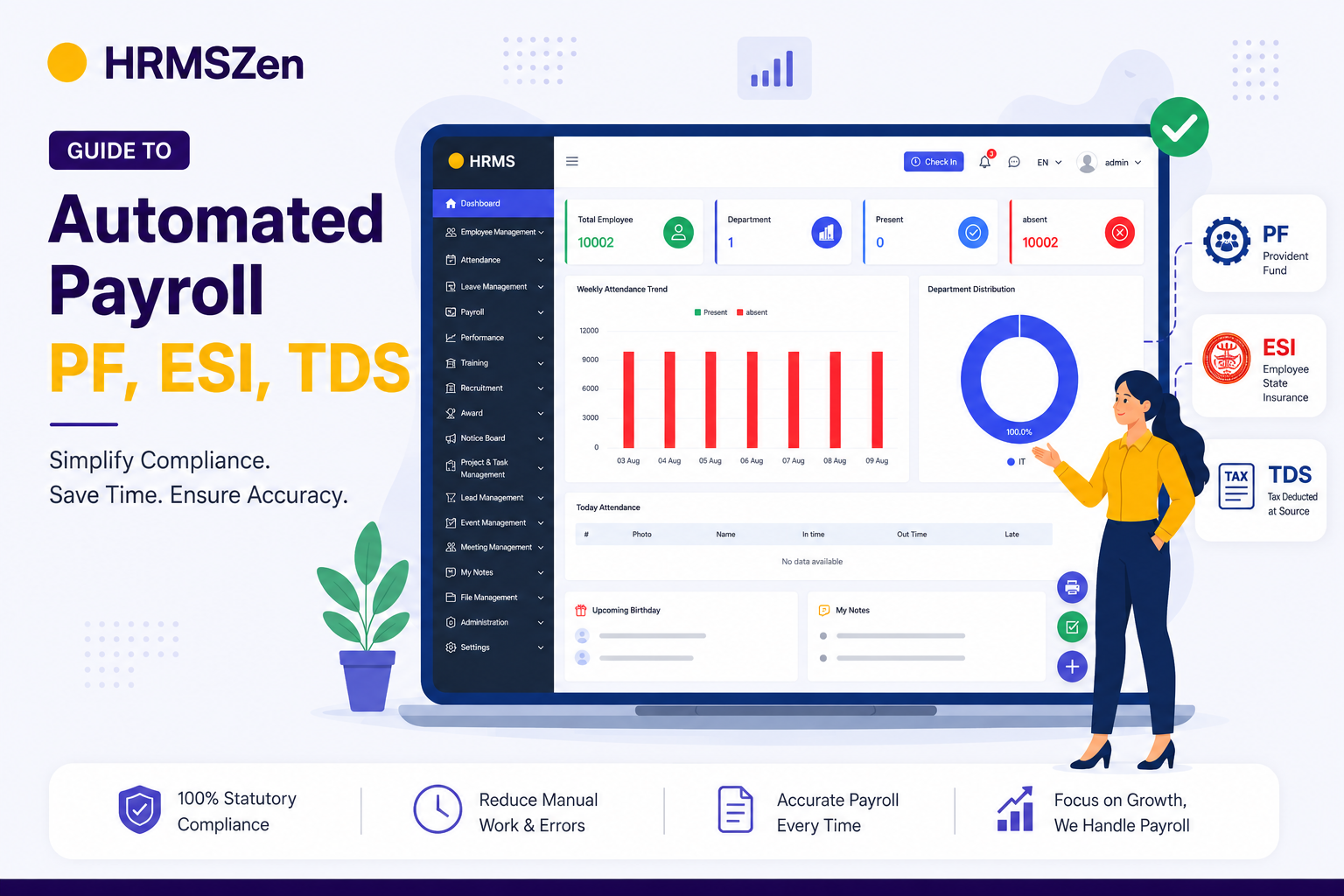
Navigating country-specific statutory labor laws is essential to protect your company against costly legal audits and government fines. An enterprise-grade HRMS built-in compliance engine automates all statutory calculations according to current legal thresholds:
A. Provident Fund (PF / EPF) Automation
For eligible employees earning up to statutory thresholds, the HRMS calculates the standard 12% employee contribution and the corresponding employer contribution split between the Employees Provident Fund (EPF) and Employees Pension Scheme (EPS). At month-end, the system generates ready-to-upload electronic Electronic Challan-cum-Return (ECR) text files formatted perfectly for direct submission to government portals.
B. Employee State Insurance (ESI) Management
For employees within ESI gross wage limits, the HRMS automatically deducts the 0.75% employee contribution and calculates the 3.25% employer contribution. Monthly contribution schedules and return summaries are generated in 1 click.
C. Tax Deducted at Source (TDS) & Income Tax Regimes
Employee income tax processing can be exceedingly complex due to dual tax regimes (Old Tax Regime with deductions vs New Tax Regime with lower slabs). An automated HRMS allows employees to submit investment declarations through an Employee Self-Service (ESS) portal. HR managers review attached digital proof documents, approve valid claims, and the system automatically computes monthly TDS deductions across all 12 pay cycles, generating Form 16 PDF files at fiscal year-end.
D. Professional Tax (PT) Slabs
State-specific Professional Tax tables are embedded into the HRMS database, automatically applying state location slabs based on the employee work location assigned in their profile.
4. Direct Bank Payout Advice Files & Digital Payslips
Once gross earnings, statutory deductions, loan repayments, and tax withholdings are calculated, the HRMS generates structured Bank Advice Files formatted specifically for direct upload to major corporate banking portals. This allows finance teams to disburse hundreds of salaries in a single encrypted batch transfer.
Simultaneously, the system generates password-protected PDF payslips featuring company branding, earnings breakup, tax deductions, and YTD summaries. Payslips are automatically emailed to employees and made available inside their ESS mobile app vault.
5. Complete Audit Trail & Variance Analytics
To ensure transparency, every payroll run logs an immutable digital audit trail recording who initialized the run, which overrides were applied, and when bank files were generated. Built-in variance reporting tools highlight month-over-month salary spikes, unexpected overtime bursts, or new joiner CTC additions before final signoff.
6. Conclusion: Transitioning to Automated HRMS Payroll
Automating payroll is no longer a luxury for growing businesses—it is a critical operational necessity. By adopting an integrated HRMS payroll engine, organizations safeguard regulatory compliance, eliminate human error, guarantee on-time salary disbursements, and free HR leaders to focus on strategic talent development.